
Implantable Contact Lenses
EVO ICL™ – EVOlution in Visual Freedom
What is EVO ICL Lens?
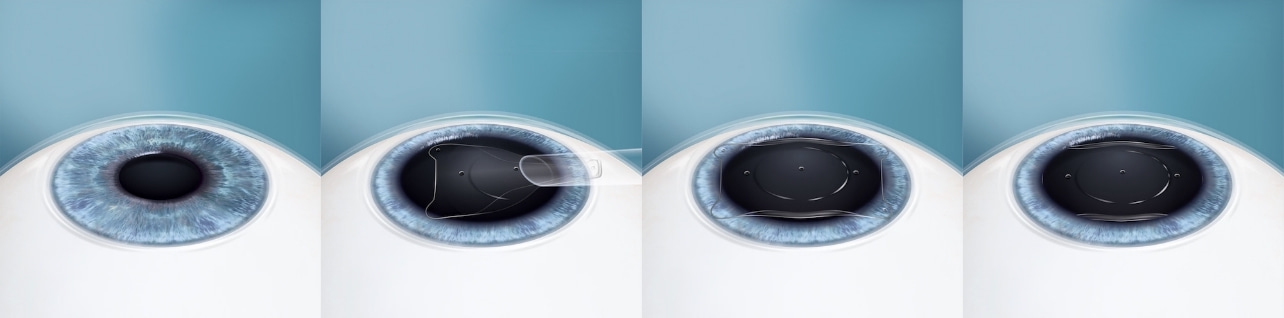
EVO ICL is an Implantable Contact Lens (ICL) designed to correct nearsightedness with and without astigmatism. The small flexible lens is placed behind the iris (the colored part of the eye) and in front of the natural crystalline lens in order to improve vision. It’s like having your doctor implant a lens similar to a contact lens into your eye so you can live without the daily hassles and maintenance of typical contact lenses.
Laser vision correction is a procedure to reshape the front surface of your cornea to improve the natural focus of the eye. There are two common procedure done to achieve this outcome, Lasik (laser-assisted in situ keratomileusis) and PRK (photorefractive keratectomy). Both of these procedures are done in a laser suite within our office. Mild sedatives are available if you are nervous or anxious the day of your surgery.
Lasik is a procedure where your surgeon numbs the eye with drops and creates a thin flap of tissue on your cornea using a laser. The flap is lifted and a second laser (excimer) is utilized to ablate or reshape the inner layers of the cornea. The cornea flap is placed back into position where it will heal.
During PRK, the surgeon will numb the eye with drops then remove the surface layer (epithelium) of your cornea. The same excimer laser will be used to reshape the cornea to correct your vision. A bandage contact lens will be placed on the eye which will remain in place until the surface tissue heals and will then be removed by your doctor.
Both procedures offer similar long-term refractive outcomes. Lasik is preferred by most patients due to the shorter healing time and minimal discomfort.
EVO ICL Procedure – What to Expect
EVO ICL lens is made of biocompatible Contact material that works in harmony with your eye. Your eye doctor will create a small opening in your cornea that will be used to insert and position the EVO ICL. For most patients, the procedure is virtually painless with numbing eye drops and it typically takes less than 20 – 30 minutes. Patients typically experience improved vision right away and a quick recovery time.
Benefits of EVO ICL
- Provides clear, sharp vision1,2
- 20 to 30-minute procedure
- Quick recovery time
- Removable by your doctor
- Offers UV protection
- Not visible once in place
- Can treat nearsightedness with or without astigmatism
- For patients who may not be candidates for LASIK or other vision correction procedures due to thin corneas3,4
- Does not cause dry eye syndrome5
- Excellent vision both day and night6,7
- Over 2 million ICLs distributed worldwide
- 99.4% of patients surveyed would have the EVO Lens procedure again8
Cost and Financing for EVO ICL
The cost of an EVO ICL procedure can vary depending on your personalized treatment plan. Many EVO ICL patients look forward to spending less in the long run with the EVO ICL compared to the continued costs of contacts and glasses. Ask about financing options and payment plans that may be available for your EVO ICL procedure.
Is EVO ICL Right for Me?
EVO ICL is well-suited for a wide variety of people. Ideal candidates for EVO ICL are aged 21 to 45 with nearsightedness, with or without astigmatism, and have maintained a stable prescription for at least one year. If you are seeking a solution to decrease or eliminate the cost and frustration of traditional contacts or glasses, EVO may be your answer. Contact us to discuss if EVO ICL is right for you.
Book Your Consultation
If you would like to see if the EVO ICL is right for you, contact us today to schedule a consultation.

1 Sanders D, Vukich J. Comparison of implantable collamer lens (ICL) and laser-assisted in situ keratomileusis (LASIK) for Low Myopia. Cornea. 2006
2 Igarashi A, Kamiya K, Shimizu K, Komatsu M. Visual Performance after implantable Collamer lens implantation and wavefront-guided laser in situ keratomileusis for high myopia. Am J Opthalmol. 2009
3 Parkhurst G, Psolka M, Kezirian G. Phakic intraocular lens implantation in United States military warfighters: A retrospective analysis of early clinical outcomes of the Visian ICL. J Refract Surg. 2011;27(7):473-481
4 Gimbel H, et al. Management of myopic astigmatism with phakic intraocular lens implantation. Journal of Cataract & Refractive Surgery, Volume 28, Issue 5, 883 – 886.
5 Ganesh S, Brar S, Pawar A. Matched population comparison of visual outcomes and patient satisfaction between 3 modalities for the correction of low to moderate myopic astigmatism. Clin Ophthalmol. 2017 Jul 3;11:1253-1263.
6 Parkhurst GD. A prospective comparison of phakic collamer lenses and wavefront-optimized laser-assisted in situ keratomileusis for correction of myopia. Clin Ophthalmol. 2016 Jun 29;10:1209-15.
7 Ganesh S, Brar S, Pawar A. Matched population comparison of visual outcomes and patient satisfaction between 3 modalities for the correction of low to moderate myopic astigmatism. Clin Ophthalmol. 2017 Jul 3;11:1253-1263.
8 Packer M. The Implantable Collamer Lens with a central port: review of the literature. Clinical Ophthalmology 2018: 12: 2427–2438
2 Igarashi A, Kamiya K, Shimizu K, Komatsu M. Visual Performance after implantable Collamer lens implantation and wavefront-guided laser in situ keratomileusis for high myopia. Am J Opthalmol. 2009
3 Parkhurst G, Psolka M, Kezirian G. Phakic intraocular lens implantation in United States military warfighters: A retrospective analysis of early clinical outcomes of the Visian ICL. J Refract Surg. 2011;27(7):473-481
4 Gimbel H, et al. Management of myopic astigmatism with phakic intraocular lens implantation. Journal of Cataract & Refractive Surgery, Volume 28, Issue 5, 883 – 886.
5 Ganesh S, Brar S, Pawar A. Matched population comparison of visual outcomes and patient satisfaction between 3 modalities for the correction of low to moderate myopic astigmatism. Clin Ophthalmol. 2017 Jul 3;11:1253-1263.
6 Parkhurst GD. A prospective comparison of phakic collamer lenses and wavefront-optimized laser-assisted in situ keratomileusis for correction of myopia. Clin Ophthalmol. 2016 Jun 29;10:1209-15.
7 Ganesh S, Brar S, Pawar A. Matched population comparison of visual outcomes and patient satisfaction between 3 modalities for the correction of low to moderate myopic astigmatism. Clin Ophthalmol. 2017 Jul 3;11:1253-1263.
8 Packer M. The Implantable Collamer Lens with a central port: review of the literature. Clinical Ophthalmology 2018: 12: 2427–2438
Quick Links
All Medical Eye Care Services
We offer every modern vision correction option to match your eyes, your lifestyle, and your goals

Keep In Touch
For non-urgent questions or to learn more about our services, contact us today!
Quick Links
Locations
Hours of Operation
- Monday 9:00am - 5:00pm
- Tuesday 8:00am - 5:00pm
- Wednesday 8:00am - 5:00pm
- Thursday 8:00am - 5:00pm
- Friday 8:00am - 5:00pm
- Saturday CLOSED
- Sunday CLOSED
- *Experiencing an emergency?
Call our regular office number after hours to reach our on-call doctor
- Monday 9:00am - 5:00pm
- Tuesday 8:00am - 5:00pm
- Wednesday 8:00am - 5:00pm
- Thursday 8:00am - 5:00pm
- Friday 8:00am - 5:00pm
- Saturday Closed
- Sunday Closed
- Monday 9:00am - 5:00pm
- Tuesday 8:00am - 5:00pm
- Wednesday 8:00am - 5:00pm
- Thursday 8:00am - 5:00pm
- Friday 8:00am - 5:00pm
- Saturday Closed
- Sunday Closed
Contact Us
To reach any of our offices with questions and to schedule an appointment, please call our main line at (724) 933-5588
© 2026 Sightline Ophthalmic Associates and Laser Eye Center. All rights Reserved -
Accessibility Statement
-
Privacy Policy
-
Sitemap
Managed and Designed by 