
Corneal Cross-Linking
A treatment designed to strengthen the cornea and help slow or stop keratoconus.
Helping protect your vision
Keratoconus can cause the cornea to weaken, thin, and gradually change shape, leading to increasingly blurred or distorted vision.
Corneal collagen cross-linking (CXL) is a treatment designed to strengthen the cornea and help slow or stop the progression of keratoconus.
Epioxa: a new approach to cross-linking
Epioxa is an FDA-approved epithelium-on (epi-on) cross-linking treatment for keratoconus in patients ages 13 and older.
With epi-on treatment, the cornea’s protective outer layer remains in place.
The procedure combines specially formulated riboflavin (vitamin B2) eye drops, controlled ultraviolet light, and supplemental oxygen to help strengthen the cornea’s collagen structure.
How Epioxa cross-linking works
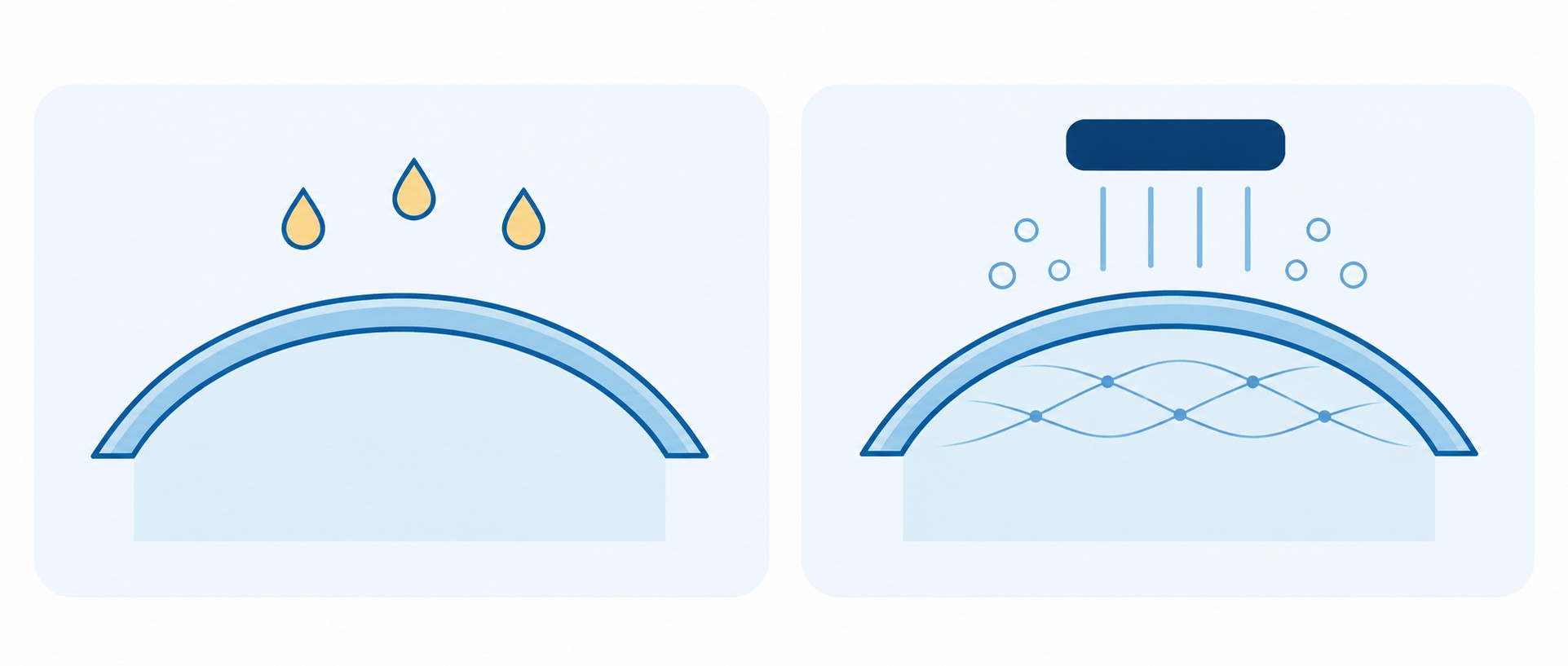
1. Riboflavin Drops
Specialized vitamin B2 eye drops are applied to the cornea while its outer protective layer remains intact.
2. UV Light and Oxygen
Controlled UV-A light, combined with supplemental oxygen, activates the treatment and helps form additional bonds within the cornea’s collagen.
Why early treatment matters
Keratoconus is a progressive eye disease. Without treatment, it can worsen over time and may lead to significant vision loss.
Glasses and contact lenses can help you see more clearly, but they do not stop keratoconus from progressing. Cross-linking is designed to help prevent further change, which is why early evaluation matters.
Signs and symptoms to know
- Rubbing your eyes often
- Blurry vision
- Trouble seeing at night
- Frequent headaches
- Changing glasses or contact lens prescriptions
- Vision that cannot be fully corrected with glasses or contacts
- A family history of keratoconus
A more stable cornea
Cross-linking is designed to help prevent further changes in corneal shape and vision. It does not necessarily eliminate the need for glasses, contact lenses, or other treatments.
What to expect
Epioxa treatment is performed by an eye doctor, one eye at a time. Because the cornea’s outer layer is not removed, the treatment is designed for improved comfort and a shorter recovery.
After treatment
Contact your SightLine doctor right away if you have severe pain in the treated eye or any sudden decrease in vision. Some discomfort is possible, and sunglasses may help if you are sensitive to light. Go home and rest, do not rub your eyes, and take any medications your doctor prescribes. Some people had their second eye treated as early as one week after the first.
Is cross-linking right for you?
Not every patient with keratoconus requires the same treatment. Our corneal specialists use advanced diagnostic testing to evaluate corneal shape, thickness, and stability before recommending an individualized approach. As with any procedure, cross-linking has potential risks and side effects, which your doctor will discuss during your evaluation.
Two treatments, not the same
Cross-linking strengthens the cornea to slow or stop progression, while CAIRS is used to help reshape it. Your doctor will recommend one, the other or both based on your condition.
| Feature | Corneal cross-linking (CXL) | CAIRS |
|---|---|---|
| What it is | Riboflavin drops and ultraviolet light strengthen the cornea’s collagen. | Small, curved segments of donor corneal tissue are placed within the cornea. |
| Main goal | To slow or stop progression of keratoconus and related conditions. | To help reshape the cornea and improve its stability. |
| Glasses and contacts | Not intended to remove the need for glasses. | May help glasses or contact lenses work better. It does not cure keratoconus. |
General guide only. Your doctor will recommend the treatment, or combination of treatments, that suits your eyes.
Common questions
Is Epioxa safe and effective?
Its safety and effectiveness were studied in two randomized, placebo-controlled clinical trials, and the FDA approved it for keratoconus in adults and patients aged 13 and older. Please see the full Prescribing Information for complete information, including risks.
Is Epioxa covered by insurance?
Coverage varies by plan. Check with your insurance provider, and call our office with any questions.
What is recovery like after cross-linking? When can I return to work or school?
Recovery varies, but many patients can return to work or school within several days, depending on their comfort and vision. Mild discomfort, scratchiness, light sensitivity or blurred vision may occur during the first days of healing. Your doctor will give you specific instructions for your recovery.
Can I wear contact lenses after cross-linking?
Yes. Most patients can return to their regular contact lenses once the eye has healed, often within a few weeks. A temporary soft bandage contact lens is typically placed right after the procedure to protect the eye while it heals. Your doctor will let you know when it’s safe to resume your usual lenses.
Will cross-linking improve my vision, or just keep keratoconus from getting worse?
The main goal of cross-linking is to strengthen the cornea and slow or stop keratoconus from progressing. Some patients notice an improvement in their vision, but the procedure isn’t intended to eliminate glasses or contact lenses. Its greatest benefit is helping preserve your vision by preventing further changes to the cornea.
Who is a candidate for corneal cross-linking?
Cross-linking is often recommended for keratoconus that is progressing or at significant risk of getting worse. Progression is more common in younger patients, but adults may benefit as well. Epioxa is FDA-approved for patients aged 13 and older, and our doctors will assess your corneal health, age and how your keratoconus is changing to decide whether treatment is right for you.
This page is general information, not medical advice. Candidacy and outcomes vary, and no result is guaranteed. A comprehensive eye examination is needed to determine your options. Treatment availability may vary by office; please contact our team to confirm.
Working with your eye doctor. Your eye doctor may recommend a specialized evaluation or treatment at SightLine. Our team works closely with referring providers to help coordinate your care.
Keep learning
Questions about your diagnosis?
Our team can help you understand your next steps, working alongside your eye doctor.