
CAIRS
Corneal allogenic intrastromal ring segments (CAIRS) are an established treatment option at SightLine for appropriately selected patients with keratoconus.
What is CAIRS?
CAIRS stands for corneal allogenic intrastromal ring segments. In keratoconus, the cornea thins and bulges into a cone-like shape. CAIRS places small, curved segments of donor corneal tissue within the cornea to help reshape it.
Who is a good candidate?
Candidacy depends on the shape, thickness and stage of the cornea and your overall eye health. Imaging helps your SightLine doctor decide whether CAIRS is right for you.
How CAIRS works
Donor corneal tissue is placed within the cornea to help reshape and support it.
- 01
Keratoconus
The cornea becomes thin and irregular.
- 02
Donor tissue segment
A small arc of donor corneal tissue is placed within the cornea.
- 03
Reshaping & support
The added tissue helps make the cornea more regular.
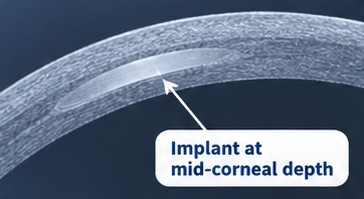
Cross-section
An illustrated scan view (OCT) showing the donor tissue segment at mid-corneal depth.
Eye view
A front view showing the faint arc segment within the cornea.

Illustrations only, not to scale. They do not show a SightLine patient, and results vary.
What to expect
Your doctor reviews detailed corneal imaging and walks you through your plan, including preparation, the day of the procedure and your follow-up.
Potential benefits
For appropriately selected patients, CAIRS may improve the shape of the cornea and the quality of vision, and help glasses or contact lenses work better. Results vary from person to person.
What to know
CAIRS does not cure keratoconus and may not remove the need for glasses or contact lenses. It is sometimes combined with cross-linking. As with any eye procedure, there are risks, which your doctor will review with you. No outcome can be guaranteed.
This page is general information, not medical advice. Candidacy and outcomes vary, and no result is guaranteed. A comprehensive eye examination is needed to determine your options. Treatment availability may vary by office; please contact our team to confirm.
Working with your eye doctor. Your eye doctor may recommend a specialized evaluation or treatment at SightLine. Our team works closely with referring providers to help coordinate your care.
Keep learning
Questions about your diagnosis?
Our team can help you understand your next steps, working alongside your eye doctor.